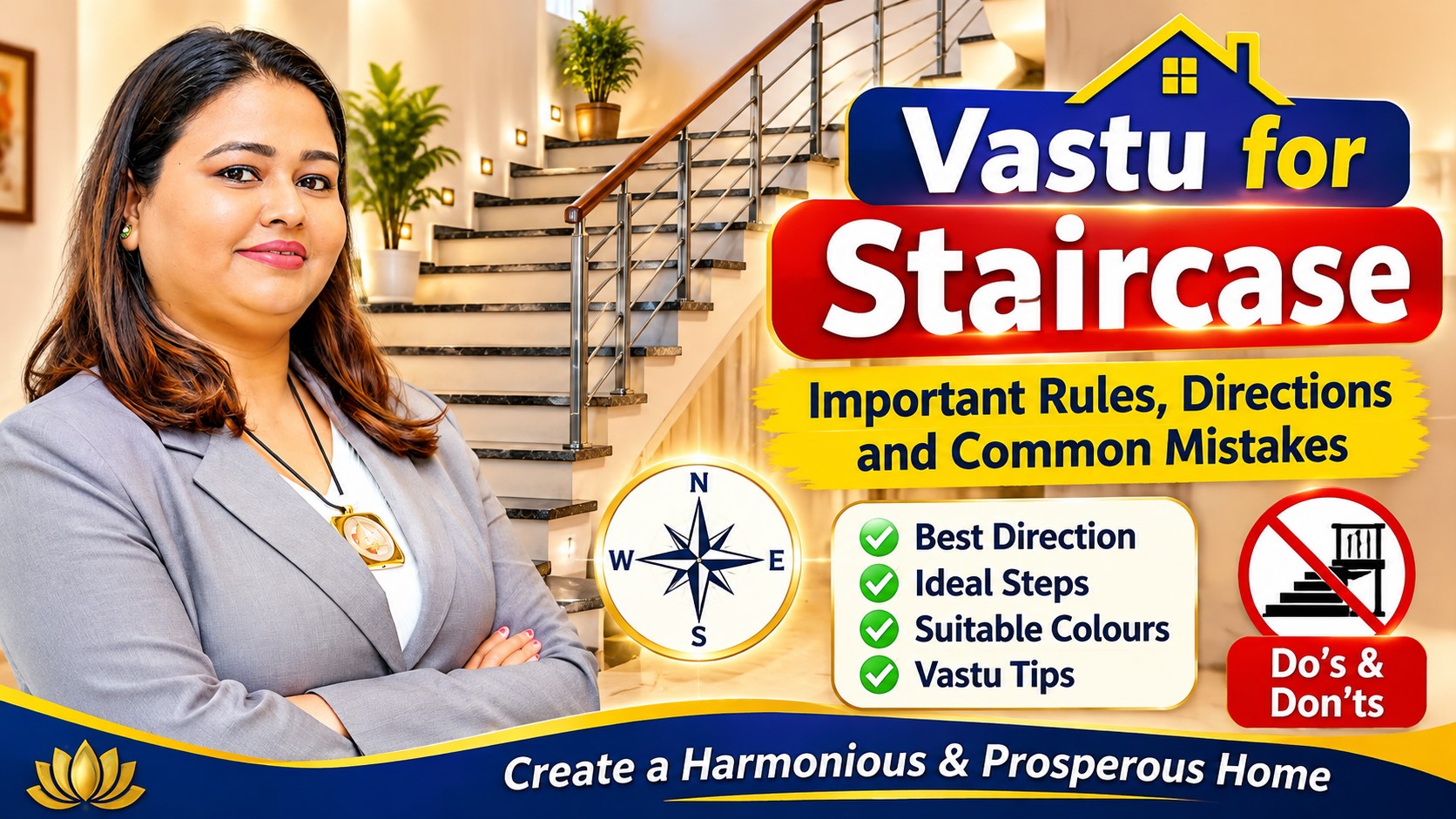
Vastu for Staircase: Important Rules, Directions and Common Mistakes to Avoid
By Sangeeta Mishra | Pyramid Vastu Consultant, Trainer & Numerologist
DRGSA – Pyramid Vastu Center Dadar, Mumbai
A staircase is an important architectural feature of a multi-storey home. Apart from connecting different floors, its location, direction, number of steps and design are also considered significant in traditional Vastu Shastra. Understanding Vastu for Staircase can help homeowners make informed decisions about staircase placement while maintaining a comfortable, balanced and well-organised living environment.
As a Pyramid Vastu Consultant with over 18 years of experience, I recommend evaluating staircase placement according to the property’s complete layout, directions and structural requirements. Here are seven important Staircase Vastu rules to consider while constructing or renovating your home.
1. Choose the South or West Direction for Staircase Placement
According to the Vastu principles followed at our centre, the South and West directions are considered the most suitable locations for staircase placement.
The staircase should be planned carefully to maintain the appropriate spatial arrangement of the property.
Vastu Do: Prefer the South or West portion of the house for staircase construction wherever the building layout permits.
Directions to Avoid for Staircase Placement:
- North
- East
- Northeast
- Northwest
- Southeast
- Southwest
- Centre of the house (Brahmasthan)
These locations are generally avoided according to the Vastu guidelines followed at our center.
Always evaluate the complete floor plan and directional alignment before finalizing the staircase location.
2. Follow the Recommended Staircase Climbing Direction
The direction in which a staircase rises is another important consideration in traditional Vastu Shastra.
A clockwise movement while climbing is commonly recommended. This means that the staircase should turn clockwise as a person moves upwards, wherever the architectural layout permits.
Vastu Do: Plan the staircase to follow a clockwise climbing direction whenever practical.
Also ensure that the steps are comfortable, properly proportioned and safe for everyday use. Avoid unnecessarily steep stairs or irregular step heights.
3. Maintain an Odd Number of Steps or Risers
According to traditional Vastu recommendations, the number of steps or risers in a staircase should preferably be odd.
This guideline is considered for both internal and external staircases.
Vastu Do: Maintain an odd number of steps or risers for the staircase inside the house as well as the staircase outside the house, wherever the design permits.
For example, 11, 15, 17, 19 or 21 steps may be considered while planning, depending on the available height and architectural requirements.
The final number should always be determined alongside comfortable step dimensions and building safety standards.
4. Choose a Suitable Staircase Shape
The shape of a staircase should complement the overall building design and available space. Traditional Vastu recommendations generally favour simple and practical staircase arrangements.
Some commonly used staircase designs include:
- L-shaped staircase: Suitable for homes where a corner arrangement is preferred.
- U-shaped staircase: Useful for multi-storey homes with limited space.
- Straight staircase: A simple design that provides direct access between floors.
- Square or rectangular staircase: Can be considered depending on the available layout.
Vastu Do: Choose a staircase design that provides comfortable movement, sufficient space and proper ventilation. Avoid unnecessarily complicated designs that interfere with the home’s circulation.
5. Select Appropriate Staircase Colours
Colours influence the appearance and atmosphere of a home. According to commonly followed Vastu recommendations, lighter and earthy shades are often preferred for staircase areas.
Some suitable colour options include:
- Cream and off-white
- Beige
- Light brown
- Soft yellow
- Light earthy shades
Vastu Do: Select colours that complement the surrounding interiors and create a pleasant appearance. Ensure that the staircase has sufficient lighting and visible step edges for safety.
Avoid choosing colours that make the staircase area look excessively dark or difficult to navigate.
6. Keep the Area Under the Staircase Clean and Organised
The space underneath a staircase is often used for storage. However, allowing unnecessary clutter to accumulate can make the area look untidy.
Vastu Do: Keep the space under the staircase clean, organised and free from unnecessary items.
If you plan to use this area for storage, consider suitable closed cabinets or shelves. Avoid allowing broken furniture, unused objects or waste materials to accumulate.
A well-maintained staircase area contributes to a more organised and comfortable home.
7. Avoid Common Staircase Vastu Mistakes
While planning a staircase, homeowners should pay attention to certain traditional Vastu recommendations and practical design considerations.
Some common mistakes to avoid include:
- Constructing a staircase in the North, East, Northeast, Northwest, Southeast, Southwest or center of the house.
- Ignoring the preferred South or West staircase placement.
- Having an even number of steps instead of the traditionally recommended odd number.
- Constructing uneven or excessively steep steps.
- Allowing insufficient lighting around the staircase.
- Ignoring ventilation and comfortable movement.
- Allowing broken or damaged steps to remain unrepaired.
- Blocking important pathways or entrances with staircase structures.
Vastu Do: Review the staircase location, direction, number of steps and design during the initial planning stage. Proper architectural planning can help avoid unnecessary structural changes later.
If your existing staircase does not follow these recommendations, do not immediately consider demolition or major renovation.
At Jiten Pyramid Center Dadar, Mumbai, professional Vastu consultation can help homeowners evaluate their property’s layout and explore suitable recommendations according to individual requirements.
Pyramid Vastu methods may also be explored as part of a broader assessment, including practical approaches that avoid unnecessary demolition or renovation wherever possible.
Frequently Asked Questions (FAQs)
1. Which direction is best for a staircase as per Vastu?
According to the Vastu principles followed at our centre, South and West are considered the most suitable directions for staircase placement.
2. Which directions should be avoided for staircase placement?
North, East, Northeast, Northwest, Southeast, Southwest and the centre of the house (Brahmasthan) are generally avoided according to these Vastu guidelines.
3. Should a staircase turn clockwise or anticlockwise as per Vastu?
Clockwise movement while climbing is commonly recommended in traditional Vastu guidelines. However, practical building design and safety should also be considered.
4. Should the number of staircase steps be odd or even?
According to traditional Vastu recommendations, the number of steps or risers should preferably be odd. This consideration applies to staircases inside and outside the house.
5. Which colour is suitable for a staircase as per Vastu?
Lighter shades such as cream, beige, off-white and light brown are commonly preferred. Choose colours that complement the interiors and provide good visibility.
6. Can we use the space under the staircase for storage?
Yes, the space can be used for organised storage, provided it is maintained properly and does not create clutter or obstruct movement.
7. Can an existing staircase be corrected without demolition?
In many cases, practical adjustments may be explored depending on the property’s structure and staircase location. A professional Vastu assessment can help identify suitable options.
8. Does staircase placement affect the overall Vastu of a home?
In traditional Vastu Shastra, staircase placement is considered one of several factors that contribute to the overall spatial arrangement. The complete floor plan should be evaluated rather than focusing on one feature alone.
Conclusion
Following these Vastu for Staircase rules can help homeowners make thoughtful decisions about staircase direction, placement, number of steps, design, colours and maintenance.
According to the Vastu principles followed at our centre, South and West are the preferred directions for staircase placement, while North, East, Northeast, Northwest, Southeast, Southwest and the centre of the house should be avoided. Maintaining an odd number of steps or risers for internal and external staircases is another important traditional recommendation.
A well-planned staircase should not only consider traditional Vastu recommendations but also provide comfort, functionality and safety for everyone living in the home.
Remember that every property is different. Before making significant structural changes, evaluate the complete floor plan and seek professional guidance to understand the available options.
At Jiten Pyramid Center Dadar, Mumbai, Sangeeta Mishra shares traditional Vastu knowledge and Pyramid Vastu guidance to help homeowners understand their property’s layout and make informed decisions for modern living.
Get Professional Pyramid Vastu Guidance
Sangeeta Mishra
Pyramid Vastu Consultant | Trainer | Numerologist
DRGSA – Pyramid Vastu Center Dadar, Mumbai
🌐 Website: https://www.drgsa.com/
🌐 Jiten Pyramid Center Dadar: https://www.jitenpyramiddadar.com/
📞 Contact: 9820819903 / 9820819904
Learn | Apply | Transform

Sri Pyramid Yantra Center was founded in Mumbai in 2006 by Mr Sanjiv Joshi and Mr Giridhar S. Shetty, driven by a shared passion for Vastu Shastra and pyramid energy. Starting as an informal home-based setup, the centre focused on helping families align their living spaces with Vastu principles using the power of pyramids. In 2008, they opened their first formal office in Goregaon, Mumbai, which quickly evolved into a full-fledged learning centre for Vastu education. To make the knowledge accessible to all, they introduced a free Vastu course with pyramid remedies, attracting students from all walks of life — housewives, architects, engineers, and college students. The course content was further enriched by incorporating pyramid tools developed by renowned expert Dr Jiten Bhatt. In 2014, growing demand led to a relocation to Dadar, Mumbai, where the centre expanded significantly in both clientele and team strength. When the COVID-19 pandemic struck, the centre seamlessly transitioned to online Vastu courses, reaching students across India and beyond. Today, Sri Pyramid Yantra Center operates from a spacious Dadar office led by Ms Sangeeta S. Mishra and a team of nine dedicated professionals. The centre offers Vastu Shastra courses in English, Hindi, and Marathi, along with personal consultancy and Jiten Pyramid Products. In nearly two decades, it has trained thousands of students and helped countless families and businesses transform their spaces — without demolition.