
Ideal Study Room Direction as per Vastu Shastra
By Sangeeta Mishra | Vastu Consultant & Pyramid Vastu Practitioner | Jiten Pyramid Center, Dadar, Mumbai
The study room is an important space for learning, concentration, planning, and professional development. Whether you are a student preparing for examinations or a working professional managing important projects, a well-organized study area can help create a comfortable and productive environment. According to traditional Vastu Shastra, the direction of the study room, the placement of the study table, lighting, and seating arrangement are important considerations when designing a study space.
In this blog, we will explore the ideal study room direction as per Vastu Shastra, along with practical tips for students and professionals.
Which Is the Best Study Room Direction as per Vastu Shastra?
According to traditional Vastu Shastra principles, the East, North, and North-East sections are commonly considered suitable for study-related activities. These directions are traditionally associated with knowledge, clarity, and positive beginnings.
However, the most suitable arrangement also depends on the floor plan, available space, windows, doors, and the individual’s practical needs.
1. East Direction for Better Focus
The East direction is traditionally associated with the rising Sun, freshness, and new beginnings. Placing a study table so that the student or professional faces East while studying is a commonly followed Vastu recommendation.
This arrangement may be considered for students attending online classes, preparing for competitive examinations, or completing regular homework. Professionals who require a dedicated workspace for planning, writing, and creative tasks can also consider this orientation.
Keep the East section clean, bright, and free from unnecessary clutter to maintain an organized working environment.
2. North Direction for Career and Learning
The North direction is another commonly recommended option in traditional Vastu Shastra. It is often associated with opportunities, growth, and professional progress.
Students who need a regular study routine and professionals working from home can consider facing North while studying or working, provided the room layout allows comfortable seating.
Ensure that the study table has enough space for books, a computer, stationery, and other essential materials. A clutter-free desk makes it easier to locate items and maintain an effective work routine.
3. North-East Section for a Peaceful Study Environment
The North-East section is traditionally associated with clarity, calmness, and spiritual awareness. Where practical, this section can be kept light, clean, and organized.
It may be used for reading, meditation, or quiet study if the room layout permits. Avoid overcrowding this section with heavy storage or unnecessary furniture when following traditional Vastu guidelines.
Remember that a peaceful study environment also depends on adequate lighting, comfortable furniture, and reduced distractions.
Ideal Study Table Placement as per Vastu
The placement of the study table is an important part of creating a functional study room. Traditional Vastu recommendations often suggest positioning the table so that the person faces East or North.
Consider these practical guidelines:
- Choose a stable study table with enough space for your work.
- Sit comfortably with your back properly supported.
- Keep frequently used books and stationery within easy reach.
- Avoid placing unnecessary decorative objects on the table.
- Position your computer screen to reduce glare from windows and lights.
- Maintain sufficient space to move around the chair comfortably.
The arrangement should support good posture and allow you to work without feeling cramped.
Study Room Vastu Tips for Students
Students need a study environment that supports regular practice and concentration. Along with traditional Vastu principles, the following suggestions can make the space more useful:
- Keep books organized: Arrange textbooks, notes, and reference materials neatly.
- Use suitable lighting: Ensure the desk is well-lit without harsh glare.
- Reduce distractions: Keep mobile phones and entertainment devices away during focused study sessions.
- Display goals thoughtfully: A simple timetable or study plan can help maintain consistency.
- Maintain cleanliness: Regularly remove unused papers and clutter.
Parents can also help children establish a fixed study schedule and provide a quiet area for learning.
Study Room Vastu Tips for Working Professionals
For professionals, a study room may also function as a home office. The goal should be to create an organized space that supports daily responsibilities.
Consider placing the work desk in a position that allows comfortable movement and minimal interruptions. Keep important documents properly stored, arrange cables safely, and ensure the chair and monitor are positioned ergonomically.
Natural light, good ventilation, and regular breaks can contribute to a more comfortable work environment. Traditional Vastu recommendations may guide the layout, but practical workspace requirements should remain a priority.
Common Study Room Vastu Mistakes to Avoid
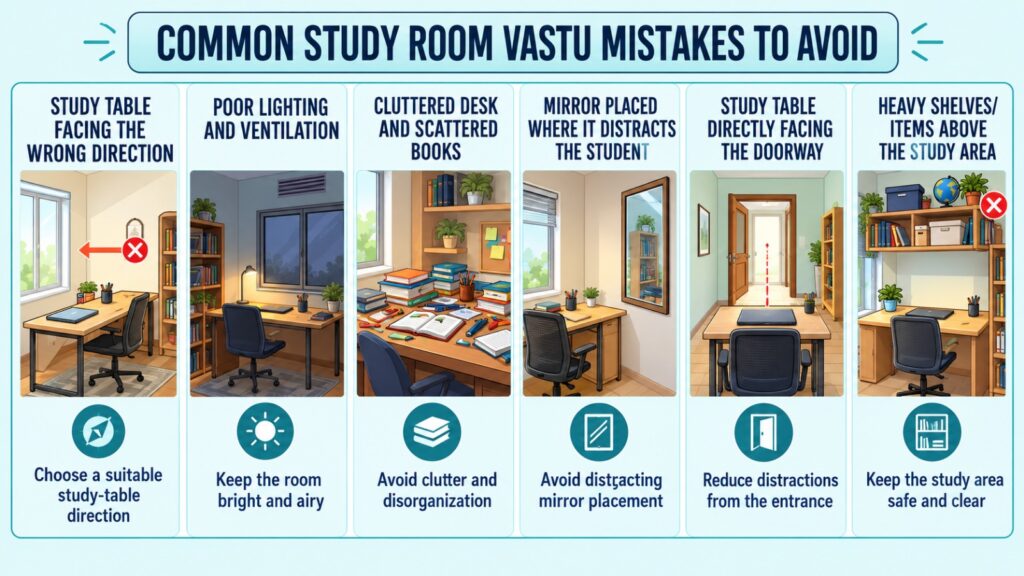
Common Study room Miatakes to avoid as per Vastu
When arranging a study room, avoid these common mistakes:
- Keeping the desk crowded with unused items.
- Studying in a poorly lit or poorly ventilated area.
- Choosing furniture that causes discomfort.
- Ignoring screen glare and electrical cable safety.
- Allowing noise and frequent interruptions to disturb concentration.
Rather than making major structural changes immediately, review the existing layout and identify simple improvements first.
Frequently Asked Questions (FAQs)
1. Which direction is best for a study room as per Vastu Shastra?
East and North are commonly recommended directions for study-related activities in traditional Vastu Shastra. The final arrangement should also consider the room layout and individual requirements.
2. Which direction should students face while studying?
According to common Vastu recommendations, students may face East or North while studying. A comfortable, quiet, and well-lit environment is equally important.
3. Is the North-East section suitable for a study room?
The North-East section is traditionally associated with clarity and calmness. It can be considered for reading or study activities when the available layout is suitable.
4. Can working professionals follow study room Vastu principles?
Yes. Professionals working from home can apply traditional Vastu recommendations when arranging their desk, seating, and workspace, while also prioritizing ergonomics and productivity.
5. Does study room Vastu guarantee better marks or career success?
No. Vastu principles are traditional spatial guidelines and do not guarantee academic or professional outcomes. Consistent effort, preparation, effective planning, and suitable working conditions remain essential.
Conclusion
Choosing the ideal study room direction as per Vastu Shastra can be part of creating a more organized and comfortable learning or working environment. East and North are commonly preferred for study table orientation, while the North-East section may be considered for quiet activities where practical.
As a Vastu Consultant, Sangeeta Mishra recommends evaluating the complete layout rather than focusing on direction alone. Good lighting, comfortable seating, proper organization, and fewer distractions can help students and professionals build a productive daily routine.
For personalized guidance on your home or workspace, explore Vastu consultancy services at www.drgsa.com.

Sri Pyramid Yantra Center was founded in Mumbai in 2006 by Mr Sanjiv Joshi and Mr Giridhar S. Shetty, driven by a shared passion for Vastu Shastra and pyramid energy. Starting as an informal home-based setup, the centre focused on helping families align their living spaces with Vastu principles using the power of pyramids. In 2008, they opened their first formal office in Goregaon, Mumbai, which quickly evolved into a full-fledged learning centre for Vastu education. To make the knowledge accessible to all, they introduced a free Vastu course with pyramid remedies, attracting students from all walks of life — housewives, architects, engineers, and college students. The course content was further enriched by incorporating pyramid tools developed by renowned expert Dr Jiten Bhatt. In 2014, growing demand led to a relocation to Dadar, Mumbai, where the centre expanded significantly in both clientele and team strength. When the COVID-19 pandemic struck, the centre seamlessly transitioned to online Vastu courses, reaching students across India and beyond. Today, Sri Pyramid Yantra Center operates from a spacious Dadar office led by Ms Sangeeta S. Mishra and a team of nine dedicated professionals. The centre offers Vastu Shastra courses in English, Hindi, and Marathi, along with personal consultancy and Jiten Pyramid Products. In nearly two decades, it has trained thousands of students and helped countless families and businesses transform their spaces — without demolition.